Shareholder lawsuit against bribery-tainted company execs could hit budget airline’s shares
Publish date:
Shareholder lawsuit against bribery-tainted company execs could hit budget airline’s shares When is a bribe not a bribe? According to Malaysia’s Prime Minister Mahathir Mohamad, who controversially chose to weigh in on a bribery scandal involving top executives at budget airline AirAsia amid ongoing official probes, a bribe is only a bribe when an inducement is pocketed for personal gain. “I hear there are allegations that AirAsia is involved in corruption. I am hesitant to comment, but usually, when governments buy equipment, we always ask for an offset,” Mahathir said on February 6. "If the money we obtain does not go into our own pocket, but instead is meant for a certain purpose, then it becomes an offset and this is not bribery. That’s my view,” he said. The premier’s remarks were widely seen as tacit approval of AirAsia business dealings that British prosecutors at the United Kingdom’s Serious Fraud Office (SFO) have deemed as fraudulent. Bribery claims involving two still unnamed AirAsia executives came to light late last month after French airplane maker Airbus admitted to paying US$50 million to secure a large aircraft order with the budget carrier. Malaysian Prime Minister Mahathir Mohamad (R) and Airbus Chief Executive Officer Guillaume Faury (L) during an Airbus-AirAsia signing ceremony in Kuala Lumpur, August 30, 2019. Photo: AFP/Sadiq AsyrafTony Fernandes, the low-cost airline’s charismatic chief executive, and his joint-venture partner, Kamarudin Meranun, have been implicated in the scandal. Both men stepped down from AirAsia temporarily last week after issuing a public statement categorically denying allegations of wrongdoing and vowing to work with investigators.
The Malaysian Anti-Corruption Commission (MACC) and national aviation and securities regulators have since opened probes into the allegations, casting a cloud of uncertainty over one of the best-known brands in Asian aviation, one that has arguably put Kuala Lumpur on the global map as a regional travel hub. The Prime Minister’s Office chose to clarify Mahathir’s statement as some critics speculated that he had sought to influence ongoing official investigations. Legal experts and others said the government procurement contract practices he referred to are not applicable to transactions by private entities that are answerable to public shareholders. “In answering to questions by the press, he (Mahathir) pointed out that it is normal for the government to request for offset to benefit from big purchases. He did not say that AirAsia was benefiting from this normal practice,” read a statement from the Prime Minister’s Office. “It is up to the investigators to determine whether it is a bribe or not.” AirAsia Executive Officer Tony Fernandes during a press conference in Kuala Lumpur in a file photo. Photo: AFP/Manan VatsyayanaThe SFO’s bribery complaint concerns a sponsorship deal involving the now-defunct Caterham Formula 1 racing team then-privately owned by Fernandes and Meranun in their personal capacities, which Airbus admitted was the recipient of a $50 million inducement. AirAsia maintains the sponsorship deal was a “branding exercise” supported by Airbus. “You cannot ‘offset’ a bribe or direct monies to be paid to others after inflating the value and calling it an ‘offset’. That is corruption,” said Dave Ananth, a former Malaysian magistrate who spoke to Asia Times. “Mahathir has his views [but] perhaps it is best not to comment whilst investigations are ongoing.” Other legal wheels are in motion, with at least one AirAsia shareholder maneuvering to take so-called statutory derivative action, a lawsuit against a director or officer of a company who allegedly committed wrongdoing. Mathew Thomas Philip, a lawyer representing the individual shareholder who asked not to be named, elaborated on the matter at a recent public event in the Malaysian capital. “The position that we are taking is that when the news broke out that a $50 million bribe was made, in my view, the board of directors had a requirement to disclose [whether] they have in their possession relevant material that this is not a bribe, that this was in fact something that was disclosed to the board,” said Philip. Section 221 of Malaysia’s Companies Act, he explained, requires directors with an interest in a contract or proposed contract to declare the nature of that interest at a meeting of the board of directors. In simple terms, if those interests are disclosed and approved by the board, they cannot be considered a bribe. A Malaysian woman walks past an AirAsia advertisement in Kuala Lumpur, May 26, 2016. Photo: AFP/Mohd Rasfan“If this payment was made, at that particular time it would be incumbent on those directors who had interest in that sports company to have declared it to the board meeting,” he continued. “Under our listing requirements, it was mandatory for them to have immediately made that announcement because it is price sensitive information.” Philip, founder and managing partner of law firm Thomas Philip, told Asia Times that his client would send a notice to AirAsia’s company’s directors on February 10 outlining his intention to take statutory derivative action. Malaysian law allows companies a 30-day period to initiate, intervene in or defend such a legal proceeding if it chooses to do so. “We don’t see any disclosure. The law is quite clear, you have to disclose this. Really, the rules are you don’t come and justify post-nondisclosure. The issue is about nondisclosure, which leads to the fact that technically, it is a secret profit,” said Philip. “There’s no such thing as ‘offset’ in the context of this case.” If AirAsia’s board of directors can substantiate that such a disclosure had been made and approved, which it has yet to do despite denials of impropriety, Philip said his client would withdraw their notice of statutory derivative action. “I think their response to the [notice] letter will say everything,” Philip remarked. When news of the bribery scandal emerged, AirAsia Group Bhd and its long-haul subsidiary AirAsia X Bhd’s shares went into free-fall. On February 5, AirAsia Group Bhd’s share price fell to 1.12 ringgit, a 52-week low, as a massive selldown saw its trading volume exceed the daily average by 430%. AirAsia X Bhd shares hit a record low of 11 sen on February 4. AirAsia Airbus A320 airplanes parked on the tarmac at Kuala Lumpur International Airport 2 in Sepang Photo: AFP/Manan VatsyayanaThough the carrier’s shares rebounded after Mahathir’s comments, market analysts expect further turbulence as separate bribery probes make headway. “AirAsia’s stock price is likely to fall further if the MACC or SFO bring successful charges against the two executives or the airline,” said Mark Pacitti, founder and managing director at investment firm Woozle Research. Both scenarios, he said, would be detrimental to the low-cost carriers and their subsidiaries future growth potential. “That level of uncertainty would likely bring forward a wave of analyst downgrades, sending the shares lower. An unfavorable result from either the SFO or MACC probes into the corruption scandal risks causing long-term financial, commercial, and reputation damage to the founder and airline that will take many years to reverse,” Pacitti said. https://www.asiatimes.com/2020/02/article/how-scandal-hit-airasia-could-fall-even-further/
Asia’s largest budget carrier is facing bribery allegations, with British authorities saying Airbus paid US$50 million for plane orders
The affair could also scupper a much-discussed merger between AirAsia and Malaysia’s struggling flag carrier Malaysia Airlines
Publish date:
Tashny Sukumaran
Published: 8:00am, 12 Feb, 2020
AirAsia has gone from strength to strength despite a series of controversies over the years – and while
Prime Minister Mahathir Mohamad has thrown the government’s support behind it once again, is there now too much turbulence for the scandal-ridden Malaysian carrier to stay aloft?
The budget airline last week faced bribery allegations that came to light after planemaker Airbus settled a corruption investigation into employee conduct by Britain’s Serious Fraud Office by paying US$4 billion in fines.
With Malaysia’s anti-corruption authorities and Securities Commission looking into the matter, questions abound not just as to the future of AirAsia, but whether a much-discussed potential merger between it and flag carrier Malaysia Airlines will come to fruition.
The British antifraud watchdog said Airbus had paid a bribe of US$50 million in the form of a sponsorship for a racing team owned by top officials from AirAsia and its long-haul sister company AirAsiaX, in return for an order for 180 planes, later changed to 135.
AirAsia denied the allegations, saying its executives “negotiated rigorously in the interests of the company and had at all times acted in good faith”, and formed a committee to review the accusations.
Chief executive Tony Fernandes and executive chairman Kamarudin Meranun announced they would stand down “for a period of two months or such other period that the company may deem fit”.
Meanwhile, an AirAsia minority shareholder has initiated proceedings on behalf of the company to recover the money paid to the racing team by Airbus. But while the airline seems to be in a tailspin, analysts say AirAsia is just too big and important to Malaysia to fail.
AirAsia chief executive Tony Fernandes (left) and executive chairman Kamarudin Meranun have announced they would stand down while the company reviews bribery allegations against it. Photo: Reuters
According to industry watchers, this is most likely why Mahathir came out in what was seen as defence of the airline following the bribery allegations. The premier said it was “normal” for business dealings to feature offset payments, as long as the money did not enter “individual pockets”. His office later walked back the remarks, clarifying that it was up to investigators to determine if the US$50 million sum was a bribe.
“[Mahathir] said that only if the money goes to individuals then it becomes a bribe. If it is not for personal benefit, then it is not a bribe in his view,” the Prime Minister’s Office said in a statement.
This is not the first scandal to plague the airline. Chief executive Fernandes and other AirAsia officials were in January summoned by Indian authorities for questioning in relation to alleged financial irregularities and potential criminal misconduct while the airline was lobbying to obtain a licence for AirAsia India in 2018. In 2017, AirAsia was forced to deny wrongdoing after an inquiry into Rolls-Royce by the SFO alleged that improper discounts were handed out.
Fernandes also came under fire that year for painting a jet in the colours of former ruling coalition Barisan Nasional to ferry around deposed ex-premier Najib Razak, who is now facing over 40 charges of graft and corruption linked to the 1Malaysia Development Berhad (1MDB) corruption scandal.
Malaysia Airlines aircraft at the Kuala Lumpur International Airport. Rumours have long abounded of a merger between the flag carrier and AirAsia. Photo: EPA
The public relations exercise for the former administration also saw Fernandes praise Barisan Nasional for the carrier’s success, but when it lost the May general election to the current Pakatan Harapan government, the AirAsia chief swiftly took to Facebook to apologise, saying he had buckled under intense pressure from the then government and regretted it.
AirAsia weathered even this political faux pas, with top leaders from the new government defending Fernandes. This stance continued even as AirAsia was at loggerheads with a slew of industry players, including a public spat and lawsuit battle with airport management company Malaysia Airports Holdings over outstanding taxes, and refusing to pay penalties imposed by regulator Malaysian Aviation Commission (Mavcom) for contravening consumer protection codes. Fernandes had aimed his ire at the regulator several times over the years, accusing it of not understanding his low-cost model.
Industry watchers suggest this continued support is not just due to AirAsia’s global success, but also the possibility of a merger with struggling Malaysia Airlines. The flag carrier has been in financial doldrums for years, losing billions as it grapples with poor international perceptions following two aviation tragedies in 2014 – the mysterious disappearance of MH370 and when MH17 was shot down over Ukraine.
In 2017, Malaysian sovereign wealth fund Khazanah Nasional – Malaysia Airlines’ sole shareholder – registered 7.3 billion ringgit (US$1.76 billion) in impairments, half of which was from keeping the airline afloat. Rumours of a merger have since abounded, with local media reporting that AirAsia is the leading bidder and the government is keen to see the deal come to fruition.
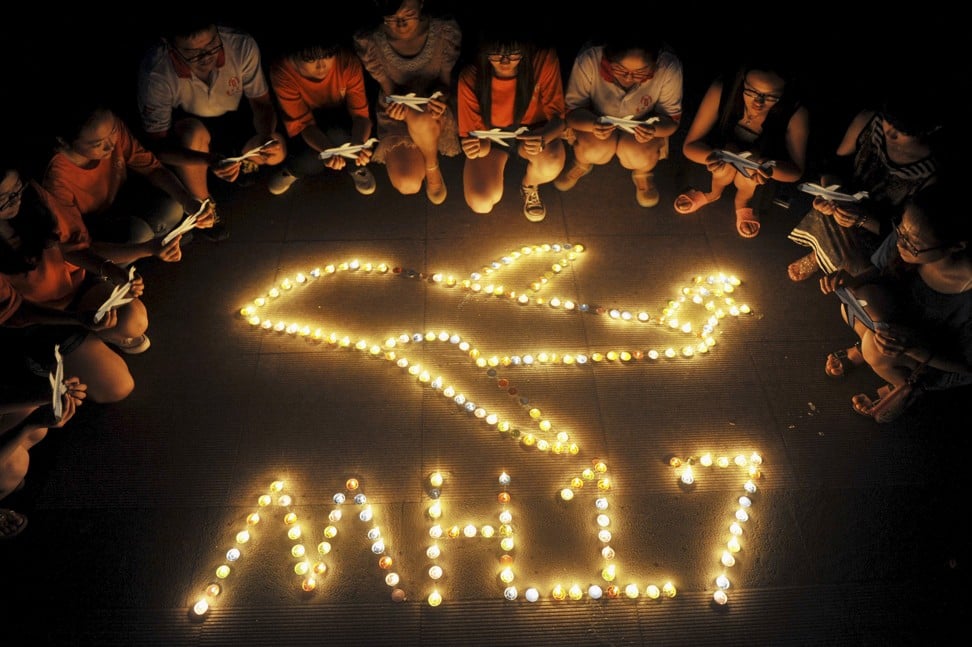
Students at a university in Yangzhou, Jiangsu province, during a 2014 candlelight vigil for victims of the downed MH17. Photo: Reuters
“Any further delay will mean continued losses by Malaysia Airlines and it is highly likely to need another cash injection by Khazanah to sustain operations,” said an insider who declined to be named.
However, analysts such as Ahmad Maghfur of Nomura warned that additional clarity was required and that anti-competition regulators had to size up the merger.
AirAsia, said Ishak Ismail of Raya Airways, has the capability to turn Malaysia Airlines around. “Any delay would be more costly to the government,” he said.
While the recent bribery issue has dented AirAsia’s reputation and seen its share price plunge, economist Yeah Kim Leng of Sunway University thinks a recovery is expected thanks to the company’s winning business model and competitive strategy in the growing Asian market.
While he pointed out that AirAsia is among the companies who “continue to remain dominant players in their respective industry” despite being embroiled in scandals, Yeah said the potential Malaysia Airlines merger was likely to be discontinued or put on hold until the internal and government investigations were completed.
This sentiment was echoed by Shukor Yusof of aviation consultancy Endau Analytics, who said that even with the allegations hounding it, the carrier was likely to weather the storm and remain the region’s largest budget carrier, describing it as “a rare Malaysian success story in an extremely difficult industry”.
“AirAsia has announced its two key executives will step down, that’s a first step,” he said. “Next is for them to clear their names.”
Recently shareholders of AirAsia Group Bhd (KLSE: AIRASIA) and Atta Global were shocked to learn that key executives in their respect companies were caught up in claims of severe misconduct. Last week, AirAsia’s name came up in a UK court judgement for a corruption trial involving aircraft manufacturer Airbus SE (EPA: AIR), in which Airbus allegedly bribed two unnamed executives – dubbed as “key decision makers” at AirAsia, by providing some US$50 million in the form of a sponsorship for a sports team owned by the two executives, in exchange for purchasing Airbus aircraft. Shares of AirAsia Group and its sister company AirAsia X slumped after the news broke. Co-founders Tan Sir Tony Fernandes and Datuk Kamarudin Meranum have since relinquished their executive roles while authorities probe the bribery claims. Separately, Atta Global has suspended executive chairman Ooi Chieng Sim, after he was among eight men charged with drug trafficking at the Magistrate’s Court in Bukit Mertajam. These eight men were accused of trafficking 4,980 grams of methamphetamine at a warehouse by the side of Atta Global’s premises in Perai Industrial Estate. Police seized several of Atta Global’s properties in Penang and luxury cars in connection with its investigations. Share of Atta Global and Heng Huat Resource (where Ooi is also executive chairman) were suspended since January 16. Accusations aside, the two incidents highlight the importance of having a good understanding of the people running the business, before you buy shares of any company. This is especially crucial in Asia where the majority of listed companies are owner-operated. Managers that are dishonest and incompetent can cause a business to lose value over time, and as investors, you would have suffered massive losses and opportunity costs if you had invested in such companies. How can we then avoid such mistakes? Well, below are five examples of management actions that could potentially undermine a company, and in turn, your investment.
Excessive compensation package
Be wary of managers who write themselves a big pay cheque when the company is producing mediocre or poor results. In doing so, they are focusing on their own interests (i.e. maximizing their compensation package) at the expense of shareholders. At the company’s 2018 annual general meeting (AGM), Sapura Energy Bhd’s (KLSE: SAPNRG) chief executive officer (CEO) Tan Sri Shahril Shamsuddin survived a bid by institutional investors to oust him as director and CEO amid unhappiness over this total pay package of RM71.92 million for the financial year ended 31 January 2018. Shahril’s remuneration of RM71.92 consisted of RM7.24 million in fixed monthly salaries (and other emoluments), RM55 million in performance bonuses, RM9.34 million under the defined contribution plan and RM348,000 for benefits-in-kind. To put things in perspective, the company recorded losses of RM2.51 billion for the same year.
Overpaying for acquisitions
In search of growth, managers often turn to business acquisition. In some cases, managers justify paying a high price for synergies that do not materialize. Instead of growth, the company faces problems of integrating the acquisition with its existing business operations. Further, if the acquisition is financed by debt, the company is saddled with unnecessary borrowings. Shares in Top Glove Corporation Berhad (KLSE: TOPGLOV) plunged in July 2018 after the company announced its acquisition price of surgical glovemaker, Aspion, from Adventa Capital could have been overstated by as much as RM714.90 million. Top Glove claimed that Aspion directors, Low Chin Guan and Wong Chin Toh had conspired to defraud and deceive it unto acquiring Aspion for RM1.37 billion. It took legal action against Adventa Capital, Low and Wong after discovering financial irregularities in Aspion’s balance sheet following the completion of the acquisition three months earlier in April 2018. Moreover since the integration, Aspion has yet to produce a significant profit for the group, at least not up to Top Glove’s expectations. Mergers and acquisitions must be considered cautiously. No matter how good a business, if you overpay for it, it could turn out to be a poor investment. It would be too late to have buyer’s remorse once an acquisition is completed.
Dubious related party transactions
In August 2019, Genting Malaysia Bhd (KLSE: GENM) announced that it had signed a term sheet to buy the stake in Nasdaq-listed Empire Resorts from Kien Huat Realty, a company controlled by Genting’s founding Lim family. Minority shareholders raised concerns of earnings erosion since Empire Resorts has been posting net losses since 2015, and the acquisition price of US$129 million implied a premium to book value. Genting Malaysia defended its decision to invest in Empire Resorts, saying the deal would place the company “in a position to more deeply access the New York market and provide both Genting Malaysia and Empire Resorts the opportunity to compete more effectively in the northeastern US region’s current competitive gaming landscape.” Time will tell if the acquisition was wise and indeed earnings accretive.
Selling utopian dreams
At its core, WeWork is a real estate company that leases long term office space in order to rent it to others in the short term. However, the company presented itself as a “tech company”, and persuaded prospective investors to buy in to its vision of becoming the “largest physical social network in the world” and a company that “elevates the world’s consciousness”. Its chief financial officer, Artie Minson even urged investors to view losses as “investments”, when the company reported a loss of US$264 million in the first quarter of 2019. Losses can be an inevitable part of starting and growing a business – a fact that is widely understood in the investing community. That said, it is important for a company’s management to be honest and forthright about these losses, and to demonstrate a path to profitability. Don’t let management charm you with unrealistic ideas and take you for a spin.
Toxic work culture
Wells Fargo & Co (NYSE: WFC) was regarded for years as one of America’s best banks. Then, in 2016, its pattern of wrongdoing became public. The bank admitted that employees had opened as many as 3.5 million phantom accounts in customers’ names to meet stratospheric sales goals. It also admitted forcing customers to buy unneeded auto insurance and charging improper mortgage fees. The scandal has been costly for Wells Fargo. Its CEO was pushed out. The bank has paid more than US$1.5 billion in penalties to federal and state authorities and US$620 million to resolve lawsuits from customers and shareholders. Three major factors contributed to Wells Fargo’s toxic sales culture: unrealistic and unreasonable expectations, minimal accountability and an atmosphere of fear. In short, Well Fargo’s executives created an environment where the results of hitting sales targets greatly outweighed corporate values of “ethics” and “doing what is right for customers”. Avoid companies with toxic business practices. VIA perspective There are several ways you can do your research on management. You can read about your managers in news articles or study their track record from annual reports. You can also listen in on interviews and company earnings calls or even ask management questions face to face in an AGM. And if you spot one or more of these management red flags, reconsider your investment. To end, we leave you with the wise words of Warren Buffet. He said that “in looking for someone to hire, you look for three qualities: integrity, intelligence and energy. But the most important is integrity, because if they don’t have that, the other two qualities, intelligence and energy, are going to kill you.”